

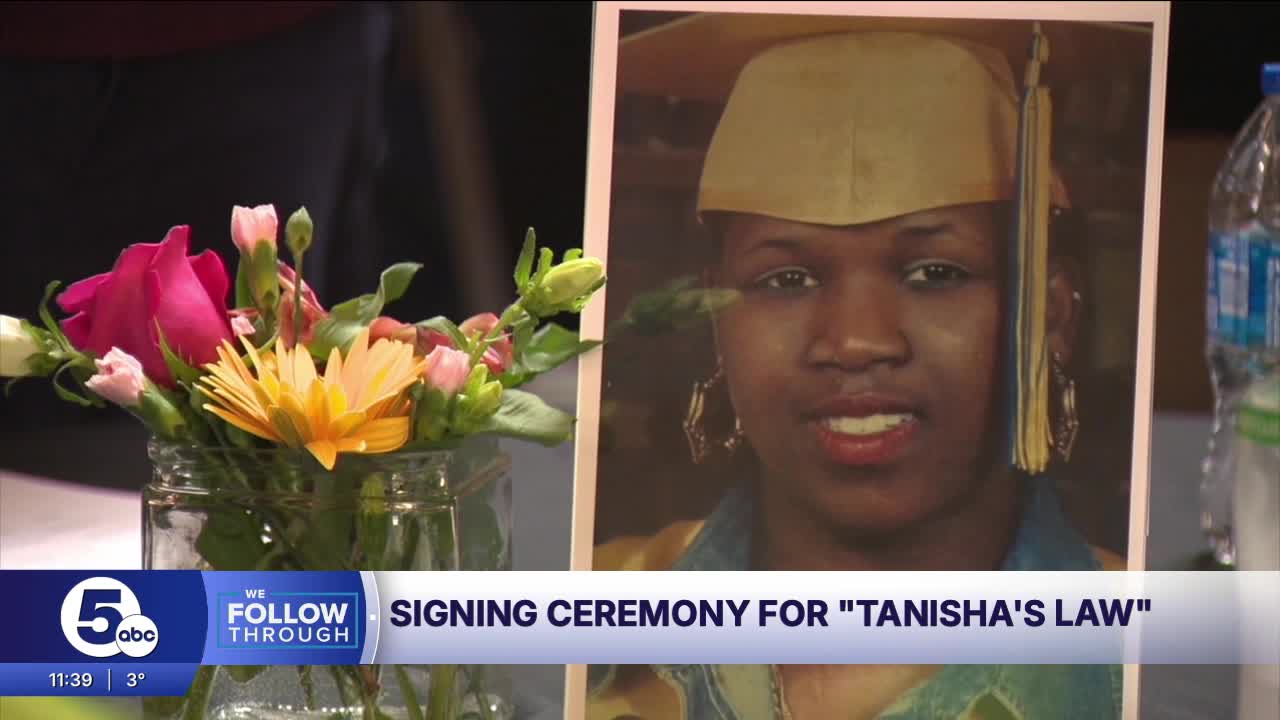



CLEVELAND — After 12 years, Tanisha’s Law has finally become a reality.
Cleveland City Council passed the law during a meeting Monday night. To celebrate, the Social Justice Law Center and the Social Justice Institute at CWRU hosted an event honoring the life and legacy of Tanisha Anderson.
Anderson was a mother who lost her life in 2014 at the hospital after a struggle with Cleveland police officers during a mental health crisis.
RELATED: 'Tanisha's Law' steps closer to reality; family shines light on mental health
During the event, Anderson’s family witnessed the signing of the law.
“I’m sorry that it took 12-years to get the change you’ve been fighting too hard for,” said Cleveland Mayor Justin Bibb.
It’s a story we’ve been following from the beginning. During a vigil days after Anderson’s death, Anderson's 16-year-old daughter at the time, Mauvion Green, said her mother was her best friend.
“She was the best person in the world; nobody can match her,” said Green.
And now her name changes the future of how Cleveland will respond to mental health crises.
Tanisha’s law creates a department of community crisis response; instead of police, trained, unarmed crisis teams will respond to calls for non-violent mental or behavioral health emergencies.
It’s providing a compassionate approach.
“I'm happy for the people who really need this and are going to get the help they really need,” said Green.
Cleveland city council member Stephanie Howse-Jones spearheaded the legislation along with Anderson’s family and local advocates from Case Western Reserve University.
“We want to send the right professional to the right place, at the right time and that's what we're doing. It is so easy to ignore the voice, the pain and the tragedy of a black woman in our society. But speaking and meeting with the Anderson family and community partners, it just continued to give me resolve that we were going to do this. We weren’t going to allow Tanisha's death to be in vain,” said Jones.
The original proposal for Tanisha’s law would have created a standalone department of community crisis response, but Bibb's administration requested that the team operate within the EMS division of the Department of Public Safety.
“There was a lot of back and forth, because we wanted to make sure we got this piece of legislation correct. And I had to fight with my team, because sometimes they're too bureaucratic with trying to get stuff done. And I remember vividly telling my safety director the residents of Cleveland don't care about the red tape or bureaucracy. They just want to see results,” said Bibbs.
Cleveland EMS says they are looking forward to addressing Cleveland’s Mental Health Crisis.
“I’m happy to see that it's transforming from a police call to something that's more compassionate, not to say police are not, but they have a whole different role. This is not necessarily a law enforcement issue, it’s addressing a medical need. This is a great way to honor Tanisha. It's going to be great because we're going to take care of these issues, we're going to take care of these folks and we're just going to head into a different direction,” said EMS Administrator Coordinator Ellen Kaziemer.
City officials said key components include:
- Creation of a Bureau of Community Crisis Response within Cleveland EMS, led by a Deputy Commissioner, to coordinate citywide crisis response efforts in collaboration with public safety, public health, and other city departments.
- Unarmed Crisis Response Teams made up of behavioral health professionals, social workers, peers with lived experience, and clinicians. These teams will be dispatched—often instead of police—to non-violent behavioral health crises, wellness checks, substance-use crises, and quality-of-life calls.
- Crisis call diversion through embedding mental health clinicians in the 9-1-1 dispatch center to route appropriate calls away from policing and toward behavioral health responses.
- Follow-up care and service connection, with responders assessing needs, providing resources, making referrals, and helping individuals access appropriate facilities or services.
Transparency and accountability, including:
- Ongoing data collection on effectiveness, outcomes, costs, and return on investment
- An annual public report on program impact and recommendations
- A public online dashboard showing response data, police hours saved, and community feedback
Expanded crisis intervention training for police, including:
- Mandatory crisis-intervention training for all officers (initial and annual refresher)
- Specialized, voluntary 40-hour training for designated Crisis Intervention Team (CIT) officers
- Stricter eligibility standards for CIT officers, excluding those with histories of excessive force complaints
- Public education and engagement, with outreach to inform residents about the new crisis response system and how to access it.
For Anderson's sister, Jennifer Johnson, it’s a bittersweet feeling.
“She's no longer here, but if this is what had to happen for her to help other people with an illness and save lives, then this was a great thing to happen. She will never be forgotten, because her name will always live," said Johnson.
