

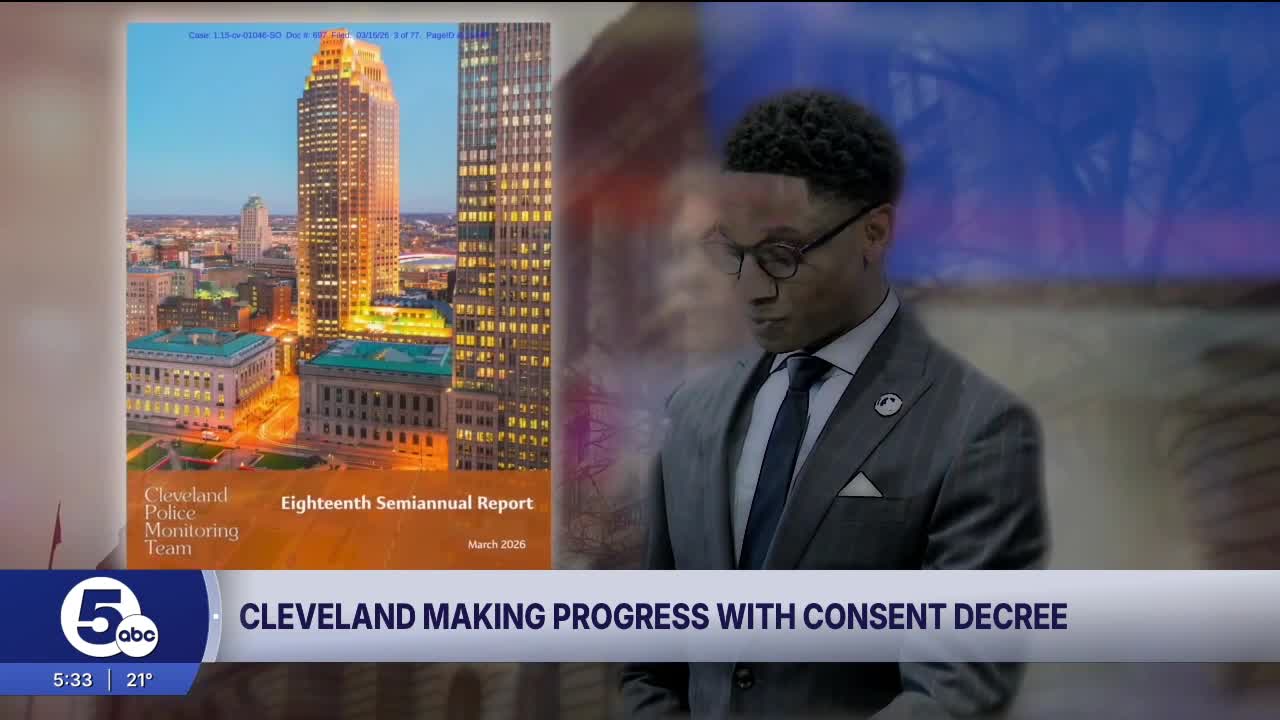


CLEVELAND — The 18th Semiannual Report from the Independent Monitoring Team was filed Monday evening, detailing the progress the Cleveland Division of Police is making towards completing federal reforms that began in May 2015.
Read the report here.
Monitor Christine Cole wrote in her letter that while Cleveland is working to make progress, there are still areas of "concern."
The report said Cleveland police have reached "substantial and effective compliance" for paragraphs related to use of force, crisis intervention and officer assistance and support.
However, no "substantial and effective compliance" has been documented for seven other sections listed, including Community Engagement and Building Trust, Community and Problem-Oriented Policing (CPOP), Bias-Free Policing, Searches and Seizures, Accountability, Transparency and Oversight, and Supervision.
Cole said that the main focus for 2026 is the civilian oversight apparatus, accountability and discipline, which are areas "still in need of work."
According to the report, Cole hopes to assess every remaining area of the consent decree by the end of the year.
Cole did not directly comment on the city's motion to terminate the consent decree, which was filed last month.
However, she and her team are working as quickly as possible to assess whether Cleveland has met the federal consent decree requirements, the letter stated.
'Much more work to do'
Cleveland Community Police Commission Co-Chair Sharena Zayed said, "After reading it [the report], I stand firm in my belief that we still have much more work to do."
"Some of the most important areas that protect the civil rights for the citizens in the City of Cleveland have not been met," Zayed said.
For example, the monitor found that over 90% of stops were constitutional. However, as our News 5 Investigation with The Marshall Project - Cleveland first revealed in 2024, Black drivers are stopped and searched at far higher rates than white drivers.
RELATED: Cleveland Police Stop and Search Black Drivers at Higher Rates Despite DOJ Oversight
Zayed said the disparities highlight the need for improved community engagement between officers and residents.
"Until we bridge the gap with the residents of the City of Cleveland and law enforcement, we are doomed to repeat ourselves," she said.
Is it almost over?
The report comes as the federal judge overseeing Cleveland police reforms considers whether to terminate the city's 2015 settlement agreement with the U.S. Department of Justice.
RELATED: Cleveland files a joint motion with Trump DOJ to end police oversight, despite unmet goals
The City of Cleveland and the Trump DOJ's motion said the city has achieved "substantial compliance" with federally mandated police reforms.
One day after the motion was filed, U.S. District Court Judge Solomon Oliver Jr. said he was surprised by the Bibb administration's news conference regarding the motion during a court hearing about the consent decree.
RELATED: Federal judge surprised by motion to end Cleveland consent decree
According to the judge, the City of Cleveland is not claiming it has met all the requirements to formally end the nearly 11-year-old consent decree, but instead said it has met the most important ones.
"I fear that it ending will set us back," Zayed said. "I know 10 plus years is a long time to be under a consent decree, but just being sick and tired of being under the decree is not a good enough reason to end it. "
Case Western Reserve University law professor Ayesha Bell Hardaway, who spent years serving on the federal monitoring team overseeing Cleveland's progress and as interim head monitor, noted several areas of reform in the consent decree were not mentioned in the city's motion. Hardaway also noted the Trump Department of Justice has not been supportive of consent decrees.
"For them to file this motion in agreement with the Trump DOJ certainly does make for strange bedfellows at this time," she said.
During a court hearing, Deputy Assistant Attorney General R. Jonas Geissler said the joint motion to end the consent decree wasn't political but rather based on Cleveland's progress.
"The facts dictate its time," said Geissler, "Not who's in charge at DOJ."
137 shots
The Cleveland Division of Police has been under federal oversight since May 2015, after a U.S. Department of Justice investigation found the department engaged in a "pattern or practice" of excessive force and raised concerns about additional civil rights violations, including the deadly shooting of Timothy Russell and Malissa Williams, known as the 137 shots incident in 2012.
On Nov. 29, 2012, a police chase involving 60 police cruisers through multiple cities in Northeast Ohio ended with 13 officers firing 137 shots into the car Russell and Williams were driving after dozens of CDP cars chased them from Downtown Cleveland to a parking lot at Heritage Middle School in East Cleveland. The pair was unarmed.
A status conference to discuss the 18th Semiannual Report is scheduled for 3 p.m. on Wednesday at the Carl B. Stokes United States Courthouse.
Judge Oliver requested party representatives with "decision-making authority" be present at the hearing.
The Community Police Commission will hold a forum, “What’s Next in Police Oversight? How Does It Affect Community Organizing?” at the Midtown Tech Hive, 6815 Euclid Ave., Cleveland, Ohio, on Wednesday from 5 to 7:30 p.m.
