

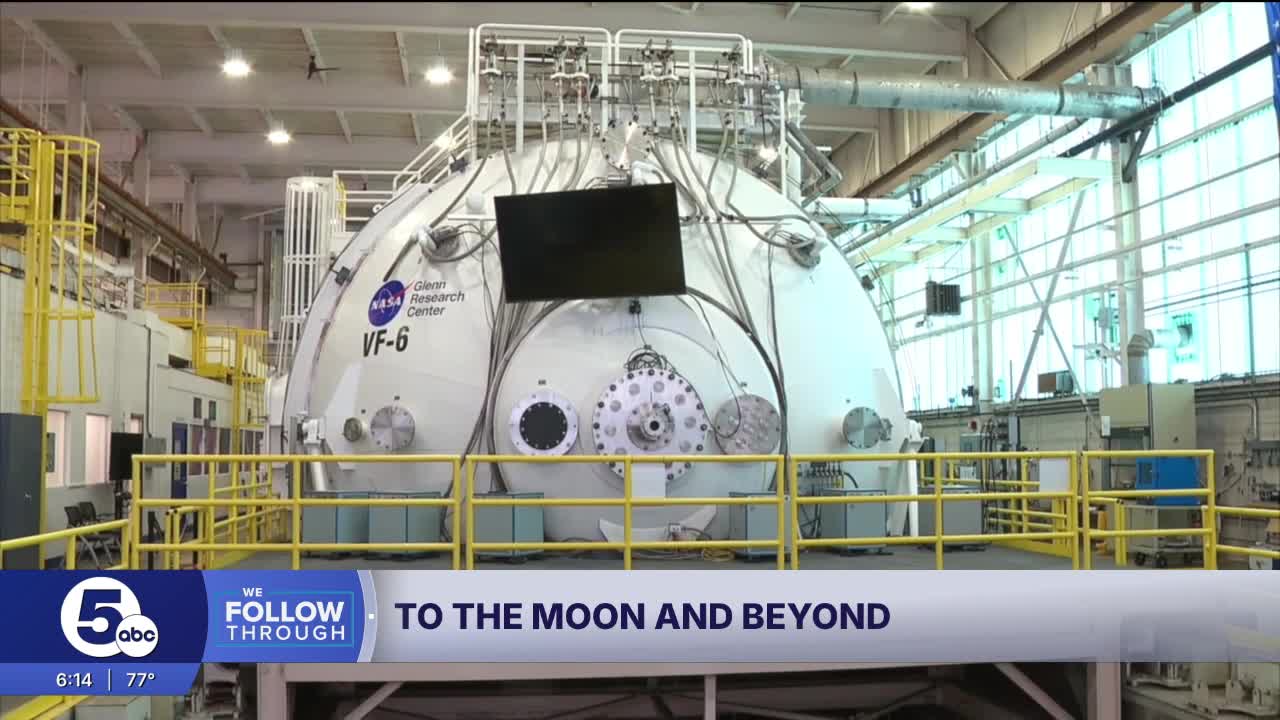


CLEVELAND — After years of development, NASA Glenn has positioned itself as a hub for nuclear development as engineers work to bring nuclear energy to the Moon and to future spacecraft travel.
Engineers are working to develop a nuclear-powered spacecraft that will help with missions traveling farther than ever before.
Nuclear power is central to the long-term vision for a lunar base where humans could live for extended periods of time because it does not depend on sunlight to generate electricity — a critical limitation on the moon, where darkness can last for extended periods.
Space Reactor 1 — Freedom, known as SR-1 Freedom, is the first nuclear-powered spacecraft of its kind.
"To me, it's the start of a new generation of spacecraft to come," said Lindsay Kaldon, deputy project manager for the Nuclear Power Module SR-1 Freedom. "Think of it as a hybrid vehicle — a hybrid rocket instead of a traditional chemical one. You can go much, much further."
Last September, News 5 first reported how NASA Glenn Research Center was picked to oversee a major space project that could bring nuclear energy to the moon, potentially involving billions of dollars in funding.
RELATED: NASA Glenn picked to help develop nuclear power...for the moon.
Watch that story here:
Kaldon also noted that the project is already drawing new business to Northeast Ohio from companies wanting to be close to the effort.
It comes after acting NASA administrator Sean Duffy issued a directive on Fission Surface Power (FSP) Development. CLICK HERE to read the full directive.
"Since March 2024, China and Russia have announced on at least three occasions a joint effort to place a reactor on the Moon by the mid-2030s," the acting administrator previously said in the directive. "The first country to do so could potentially declare a keep-out zone, which would significantly inhibit the United States from establishing a planned Artemis presence if not there first."
Before heading to the moon, NASA plans to test the technology on Mars. SR-1 Freedom is planned to send helicopters to the red planet to scan its surface.
"When we get the successful data from that, we can now say that is a proven reactor operated in space; now you can take that reaction and place it on the surface of the moon," Kaldon said.
NASA Administrator Jared Isaacman emphasized the significance of the work being done at Glenn during a conversation with News 5 earlier this year.
"The workforce showing up here is literally changing the world. What we're doing with nuclear power and propulsion is going to power humanity's next giant leap among the stars," Isaacman said. "Our ability to explore the outer planets in our solar systems directly depends on the work that's happening here at Glenn with nuclear power."
RELATED: New NASA Administrator visits Cleveland, talks future with the moon, Mars and NASA Glenn
SR-1 Freedom is expected to launch by the end of 2028. A launch for a lunar reactor on the moon, known as LR-1, is scheduled for 2030.
Clay LePard is the Ashtabula, Geauga and Portage counties reporter at News 5 Cleveland. He also covers NASA Glenn Research Center. Follow him on X @ClayLePard, on Facebook ClayLePardTV or email him at Clay.LePard@wews.com.
