

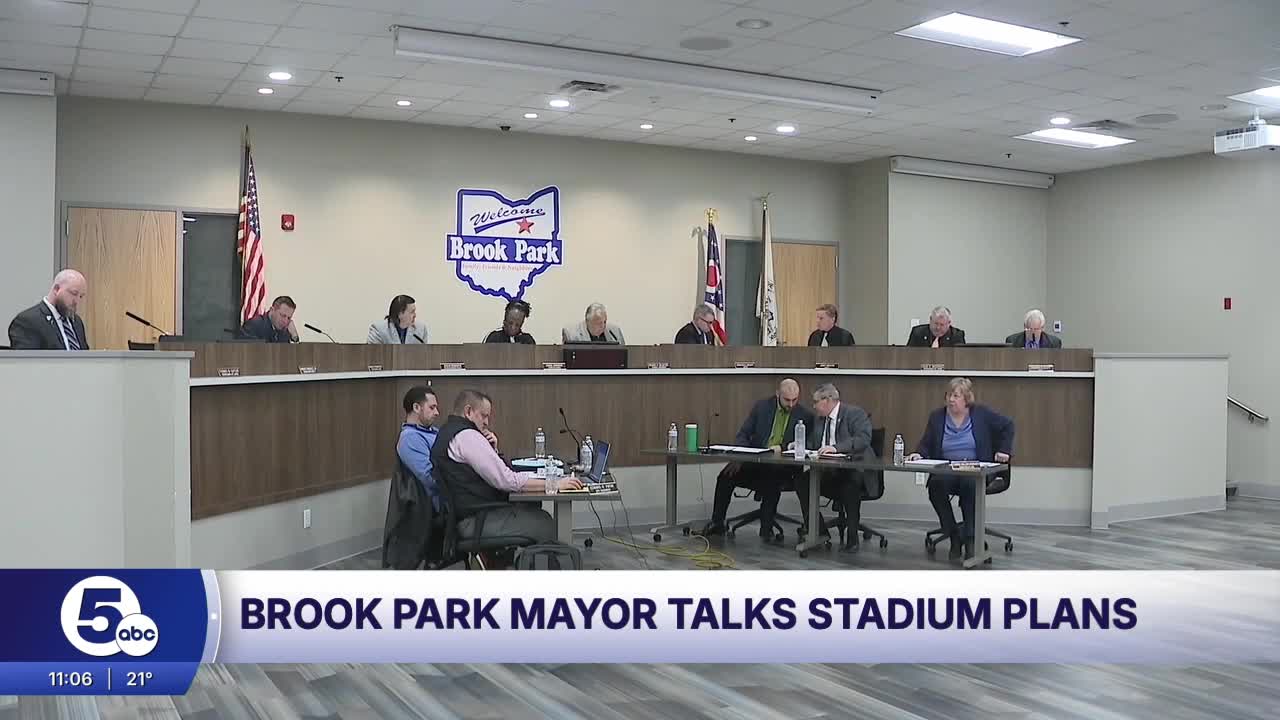


BROOK PARK, Ohio — A last-minute resolution added to Tuesday night's Brook Park City Council agenda shows the city plans to seek federal funding to help pay for transportation projects stemming from the new Cleveland Browns stadium.
Brook Park Mayor Edward Orcutt is asking for council's support to apply for a $25 million grant through the U.S. Department of Transportation's Better Utilizing Investments to Leverage Development, or BUILD, program. That competitive program provides money for road and transit projects that have a significant local or regional impact.
The council resolution was introduced Tuesday night and got an initial reading. It will need to go through two more readings before being voted on. Orcutt said council could call a special meeting Feb. 17 to speed up the process. Read the resolution here.
Council members will need to make a decision fast. The deadline to submit the grant application is Feb. 24.
"There's certainly a lot more work that we have to do," Orcutt said of finalizing the city's deal with Haslam Sports Group and getting through a series of public approvals. "We continually work behind the scenes on being able to work on a preliminary development plan and a final development plan. Our mindset is show up to work the next day and continue to keep grinding."
The council resolution doesn't say exactly what the grant would be used for. But the city and the Browns have a list of public infrastructure projects on the drawing board.
Brook Park already is seeking $70.3 million from the state to reconfigure freeway ramps, clean up a tangle of streets and build a pedestrian bridge near the stadium site.
RELATED: Brook Park, Browns make their pitch for $70.3 million in state transportation money
Ohio's Transportation Review Advisory Council, or TRAC, is weighing that request against applications from other transportation projects across the state. There's a limited pool of money - and lots of demand.
A final decision on that state funding is expected in April. A draft list of likely award recipients will be released in March, according to a schedule posted on the Ohio Department of Transportation's website.
Separately, Haslam Sports Group hopes to include a Greater Cleveland Regional Transit Authority Rapid train station at the western edge of the development site. Building a new station could cost $40 million, according to early estimates, and RTA officials have said they're not going to pick up the tab.
From the outset, Haslam Sports Group and Brook Park have said they could pursue federal money to help fill funding gaps for public infrastructure work, including road changes.
In a letter attached to Brook Park's TRAC funding application last year, Haslam Sport Group President Dave Jenkins identified several possible sources of federal money for transportation projects, including the BUILD program. He also mentioned a state loan program and the possibility of tapping future property-tax revenues from the 180-acre stadium district site to pay for public infrastructure.
The Brook Park council resolution includes support letters from Orcutt and Browns owners, Jimmy and Dee Haslam. Those letters are addressed to Transportation Secretary Sean Duffy.
The letters show that a Haslam Sports Group affiliate will provide any matching funds that the BUILD grant requires - and will cover any cost overruns for the work outlined in the grant application, if necessary.
Brook Park's move to apply for BUILD funds comes as the Browns are preparing to start digging a deep hole on the stadium site. On Tuesday, Jimmy Haslam told reporters the Browns will break ground for the stadium in early March.
RELATED: Jimmy Haslam says Browns will break ground on enclosed stadium in Brook Park on March 2
"It's been work every single day, but it's been a lot of fun, and I think this is a good sign that shows that undeniably, you know, this is positive momentum for this project, and we're excited for that," Orcutt said Tuesday.
The BUILD program has had several names since it was created as part of the American Recovery and Reinvestment Act of 2009. It was previously called the Rebuilding American Infrastructure with Sustainability and Equity (RAISE) and Transportation Investment Generating Economic Recovery (TIGER) program.
