

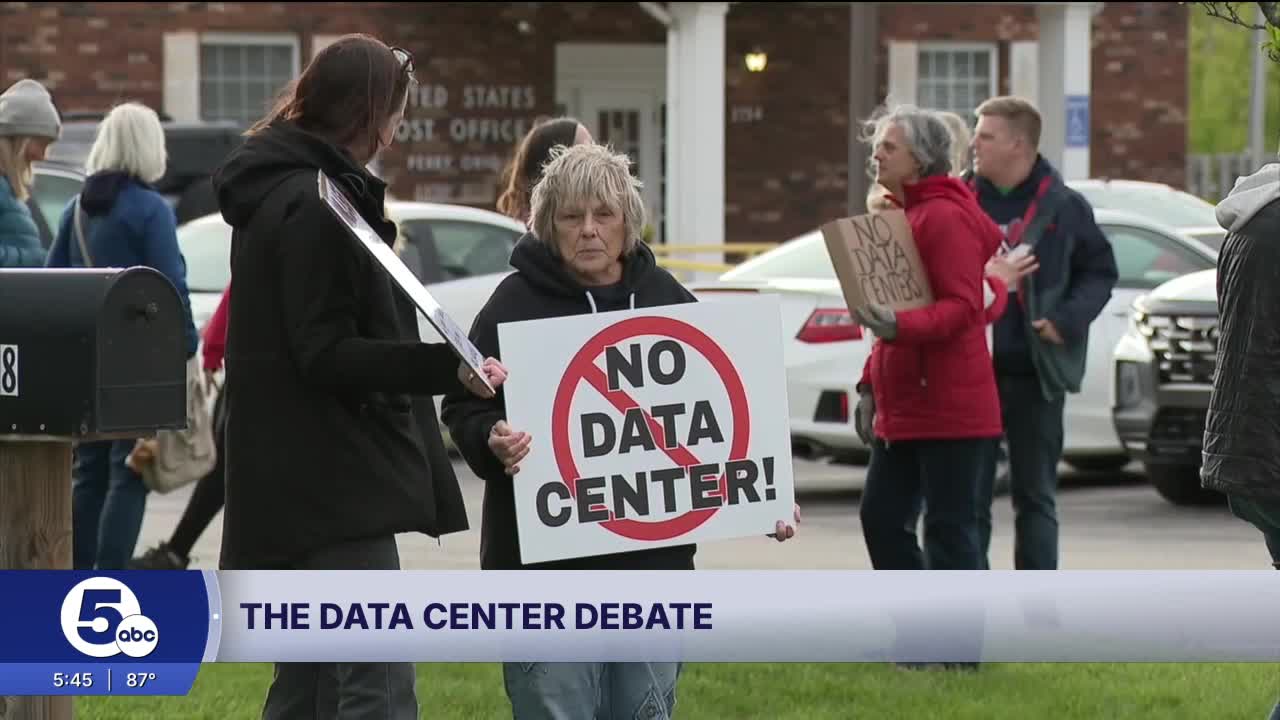



CLEVELAND — The Greater Cleveland Partnership is wading into the data center debate, urging Northeast Ohio communities to stop pressing pause on new projects.
The metropolitan chamber of commerce, which has more than 12,000 members, says the risks of development moratoriums are greater than the rewards. The group is asking local governments to consider each data center proposal based on its individual merits, rather than imposing blanket blocks on permitting and construction.
GCP is responding to a recent wave of moratoriums sweeping across Ohio.
Over the last few weeks, communities including Twinsburg, Ravenna, Avon and Painesville Township have passed short-term prohibitions on data centers, pumping the brakes for six months to a year. Cleveland City Council is considering a moratorium of up to a year, citing the need to look more closely at zoning rules and other local regulations.
RELATED: Cleveland City Council is considering a moratorium on new data center projects
Meanwhile, a grassroots campaign is proposing a constitutional amendment to ban construction of new large-scale data centers across the state. They’re collecting signatures to put the question before voters in November. But the volunteers are a long way from their goal, with about 6% of the total signatures they need to gather by July 1.
“When we see communities passing moratoriums or … activist groups considering a ban, that’s a problem,” Baiju Shah, GCP’s president and CEO, said during an interview Tuesday morning. “It’s a problem because it signals that we’re not open for business. That we’re not open for growth.”

He said the chamber is trying to encourage “smart growth,” instead, pointing out that data centers are critical facilities for everything from national security to cloud storage and artificial intelligence.
“If you have a cell phone in your pocket, you are using data centers,” Shah added.
But, he said, “this, like many topics, has become one where there’s a lot of emotion — not always infused with a lot of information.”
GCP’s position is that communities with moratoriums will miss out on investments, driving developers and tech firms to other parts of the state and the Great Lakes region. And Northeast Ohio officials will lose the chance to shape projects that will still impact their constituents by tapping into shared infrastructure, from water systems to a 13-state power grid.
On Monday, GCP released a set of guiding principles for data center projects. That list includes the expectation that data center operators will pay the full cost of the power they use, along with the bill for transmission upgrades and connections to the electric grid.
The chamber also says the facilities should minimize their water use; find ways to capture and reuse excess heat generated by computing equipment; ensure that noise isn’t a problem for neighbors; commit to community benefits, including local hiring and job training; and buy products and services from Ohio companies, whenever that’s possible.
“If incentives are necessary,” the chamber’s position statement says, “they should be performance-based,” with the ability for communities to claw back money if companies don’t follow through on their commitments.
The Cleveland Building & Construction Trades Council put out a similar statement Tuesday, advocating for “sensible regulations” instead of temporary pauses on development. The construction industry is a major beneficiary of the data center boom, which is keeping tens of thousands of laborers busy across the state.
RELATED: Ohio's data center boom really started in New Albany. We went there to see what it looks like.
“Communities that block data center development will forfeit revenue, jobs and influence while still relying on data centers for essential digital services,” the construction group wrote, noting that the facilities process, store and back up critical information for public safety, education and transportation, along with industries ranging from health care and finance to manufacturing.
The Ohio Chamber of Commerce Research Foundation released a study about data centers in September. Consultants found that Ohio attracted more than $40 billion in data center investments between 2017 and 2024, luring companies with the prospect of a state sales-tax break on data center equipment and construction materials.
In 2024 alone, the state provided $554.9 million in sales-tax breaks for data centers. Local sales-tax breaks for those projects totaled $166.8 million, according to numbers from the Ohio Department of Taxation.
RELATED: Ohio's spending billions on tax breaks for data centers. Now an incentive battle is brewing.
Amid mounting public pushback and anxiety about the rise of artificial intelligence, state lawmakers are considering ways to regulate the industry. This month, members of the General Assembly launched a bipartisan committee to study data centers.
RELATED: As more Ohio towns block data centers, lawmakers move to study impacts
Pending bills seek to scrap the state sales-tax exemption for new projects — or get rid of data center incentives entirely. At the other end of the spectrum, there’s legislation that would limit what state and local governments can do to restrict data center development.
In an email alert to clients last month, the Vorys law firm — which is working with big tech firms and major real estate developers — warned that temporary government restrictions on data center construction are likely to lead to legal fights.
Shah said the Greater Cleveland Partnership isn’t taking a stance on any individual project. But the chamber is worried about a trend, as moratoriums spread from one town to the next, from farmland to growing suburbs to more urban areas.
“If too many communities in our region adopt that posture,” said Shah. “As a region we’re going to hinder our ability to compete effectively in an AI-powered economy.”
Michelle Jarboe is the business growth and development reporter at News 5 Cleveland. Follow her on X @MJarboe or email her at Michelle.Jarboe@wews.com.
